
Chiang Mai has more temples, markets and day trips than most people can fit into a week, so the real question is what deserves your limited time. This guide gives a short, opinionated list for backpackers, first-time visitors and long-stay nomads, with the trade-offs for each pick. It also covers how to get around and how burning season changes what is worth doing outdoors. Fees and hours below come from recent third-party listings and can change, so confirm anything you plan to pay for.
Temples worth the trip (and the ones you can skip)
Chiang Mai has dozens of temples in and around the Old City. You do not need to see them all. Two or three, chosen well, are enough for a short stay.
Doi Suthep is the one to prioritize. Wat Phra That Doi Suthep sits on a mountain about 15 km northwest of the Old City, roughly 30 to 40 minutes by road. One recent guide lists foreign admission at 30 THB, with a separate national park fee of 100 THB for foreign adults introduced in October 2025. Another listing gives a slightly different figure, so treat the exact number as approximate. The cable car is optional, and the alternative is the staircase of 306 steps.
Cover your shoulders and knees, and expect to take your shoes off at the shrine. Go early in the morning or late in the afternoon. Midday is crowded and, in hazy months, the view over the city may be mostly grey.
In the Old City, Wat Phra Singh and Wat Chedi Luang are the two most commonly recommended, and both are an easy walk or short ride from most central guesthouses. If you are choosing where to base yourself, the Chiang Mai neighborhood guide explains which areas are walkable to the Old City temples and which are not.
| Temple | Worth it if | Time needed | Cost note |
|---|---|---|---|
| Wat Phra That Doi Suthep | You want the one big temple and a city view | 2 to 3 hours | About 30 THB temple entry reported; park fee and cable car extra |
| Wat Phra Singh | You want a major Lanna temple in the Old City | 45 to 60 minutes | Varies; check at the gate |
| Wat Chedi Luang | You like ruined chedis and a central stop | 45 to 60 minutes | Varies; check at the gate |
| Wat Pha Lat | You prefer a quiet forest temple and a short walk | 1.5 to 2 hours | Check locally |
Skip it if you are short on time: the smaller Old City temples. They are pleasant to pass, but none justifies a special trip. If one is on your route to a market or cafe, step in. Otherwise save the energy.
Markets and street food worth planning an evening around
Markets are where Chiang Mai does best for the money, and they double as dinner.
- Sunday Walking Street runs along Ratchadamnoen Road through the Old City. It has crafts, street food, live music and massage stalls. It is popular, so arrive before about 5 pm if you want to move freely.
- Saturday Night Market on Wualai Road is smaller and next to Wat Sri Suphan, the silver temple. It is an easy add-on if you are in the area.
- Night Bazaar on Chang Klan Road is open every evening. It is the most tourist-oriented of the three, so go for the food court and souvenirs, not for anything local.
- Warorot Market is often described as the oldest market in the city, and it is where locals shop. Go in the daytime for snacks, produce and northern Thai food.
The catch is that the Sunday and Night Bazaar markets are built for visitors. Prices for crafts are not always the cheapest, and the food stalls get long queues. Warorot and local side-street stalls are better for a cheap, quick meal. Bring cash in small notes for all of them.

Day trips and nature outside the city
Doi Inthanon National Park is the main day trip. It holds Thailand’s highest peak at 2,565 metres, and it is about 90 km from the city, around two hours each way. Highlights include the Royal Twin Pagodas, Mae Ya Waterfall and the Kew Mae Pan nature trail. Third-party listings give the foreign adult entry fee as 300 THB, with extra charges for vehicles, the pagodas and a guide on the Kew Mae Pan trail. There are no ATMs inside, so bring cash. Check current fees on the Department of National Parks website before you go.
Good choice if you want cool air, views and waterfalls in one long day. Skip it if you have less than a full day. Most people go on a group tour or with a hired driver. A scooter is possible, but it is a long ride with climbs, so only take it if you are an experienced rider.
For something shorter, try the Pha Lat Temple and Monk’s Trail. It is a forest walk close to the city and fits into a half day. Sticky Waterfall (Bua Tong) is another popular half-day option because you can walk up the rock. Public songthaews do not cover these places reliably, so plan for a scooter, a Grab or a tour. Verify current access before you go, especially after heavy rain.
Elephant sanctuaries: what to check first
Quality varies widely. Before booking, check for these things:
- No riding, and no shows or tricks.
- No chains used for long periods, and enough space for the animals to roam.
- Limits on close contact. Be cautious about places that promote on-demand bathing or constant hugging.
- Clear information about where the elephants came from and how many visitors are allowed per day.
This is general guidance, not an endorsement of any operator. If a place is cheap, crowded and promises endless photo opportunities, that is usually a warning sign. Check recent independent reviews, and ask animal welfare groups if you are unsure.
Classes and experiences worth doing once
Thai cooking class. This is the easiest half-day experience to book. Many include a market visit and a set menu. It suits a single afternoon, and it is one of the better rainy-day options. Compare menus and group sizes rather than just prices.
Muay Thai. Watching a fight is a good evening out, and training is a longer commitment. Our guide to where to watch Muay Thai fights in Chiang Mai covers venues and what to expect.
Massage or massage courses. A single massage is an easy break between temples. Courses run for several days, so they suit longer stays rather than a short visit.
Getting around to do all this
Within the Old City, walking works. Beyond it, you have three realistic options:
- Songthaews (red shared pickup trucks) are cheap for city trips. Agree the fare before you get in.
- Grab is simple and has a visible price. It is handy for temples and markets, but less reliable for remote areas.
- Scooters give the most flexibility for day trips, and they are also the riskiest choice.
If you rent a scooter, you need a valid licence that covers motorcycles. Riding without one can mean fines, and travel insurance policies commonly refuse claims after an accident when the rider is unlicensed. Check Thai government guidance and your own insurer’s wording before you rent. Photograph the bike before you ride, wear a helmet, and avoid riding after dark or in heavy rain. If you are not confident on busy roads, a Grab or a tour is the safer way to see the outskirts.
For the full cost and transport picture, see the Chiang Mai travel guide.
Timing it right: season and air quality
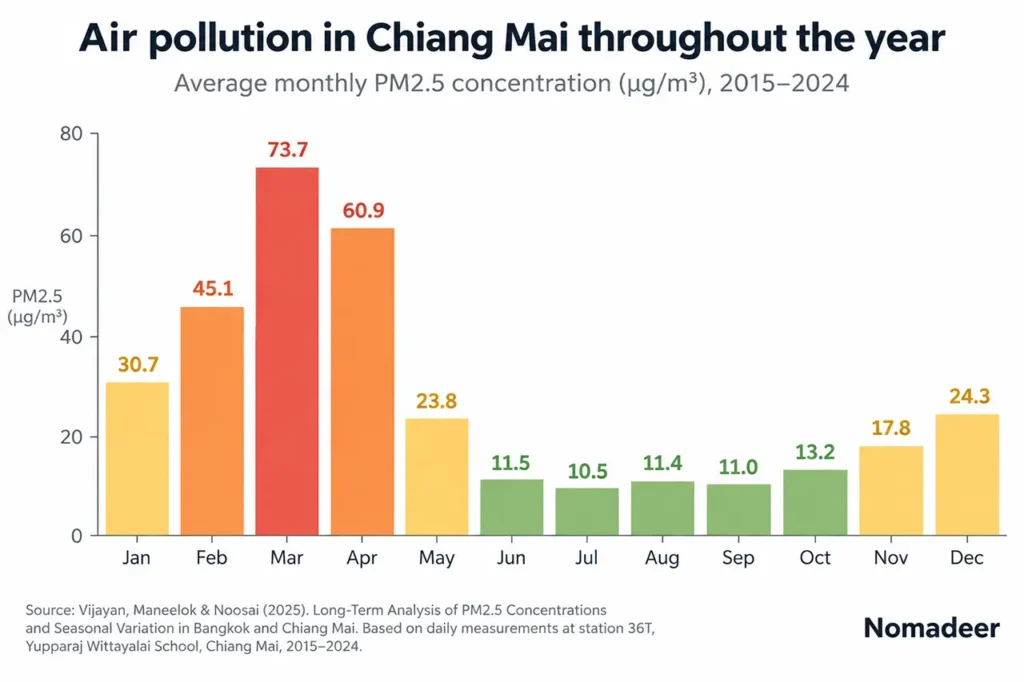
Smoke season changes the plan more than any other factor. It varies by year, but sources broadly put it between roughly February and April, with March usually the worst. IQAir describes northern Thailand’s burning season as typically running January to April and peaking in March. November to January is usually clearer.
In 2026, haze was severe in early April, and official reports cited PM2.5 readings far above Thailand’s 24-hour standard of 37.5 micrograms per cubic metre. In those weeks, viewpoints, Doi Inthanon and hikes are often not worth it, and even a walk through the Old City can be unpleasant. Indoor options such as cooking classes, massage and fights hold up better.
Check live readings on IQAir or the government’s Air4Thai site before booking outdoor days. If you have asthma or other respiratory problems, consider avoiding the peak weeks entirely.
How many days do you need, and what changes if you stay longer?
Is 3 days enough? Yes for the highlights. A workable plan is: Doi Suthep and one Old City temple on day one, a cooking class and a market evening on day two, and Doi Inthanon or a nature half-day on day three. Add a Sunday if you can, for the Walking Street. Five days lets you add a second day trip and a Muay Thai night without rushing.
Long-stay nomads need a different list. After the highlights, the things that hold up on repeat weekends are local markets, hikes, classes and short trips in clear months. If you are working from the city, the Chiang Mai digital nomad guide covers coworking, neighborhoods and living costs, which affect how much free time and energy you will have.