
Most travelers reach Pai by shared minivan, some ride a rented scooter, and a smaller group pays for a private car. The road is about 130 to 135 km and takes roughly three to four hours either way, so the real decision is comfort, risk and flexibility, not time. This guide compares the options, with prices as listed in October 2026 and what each one costs you in nausea, safety and luggage hassle.
The route at a glance
The trip runs north from Chiang Mai on Route 107 to Mae Malai, then onto Route 1095 into the mountains and down into the Pai valley. Most sources put the distance at around 130 to 135 km.
The road is paved and generally in decent shape, but it is narrow and almost constantly bending. You will see “762 curves” repeated everywhere. It is a widely quoted figure, although we did not count.
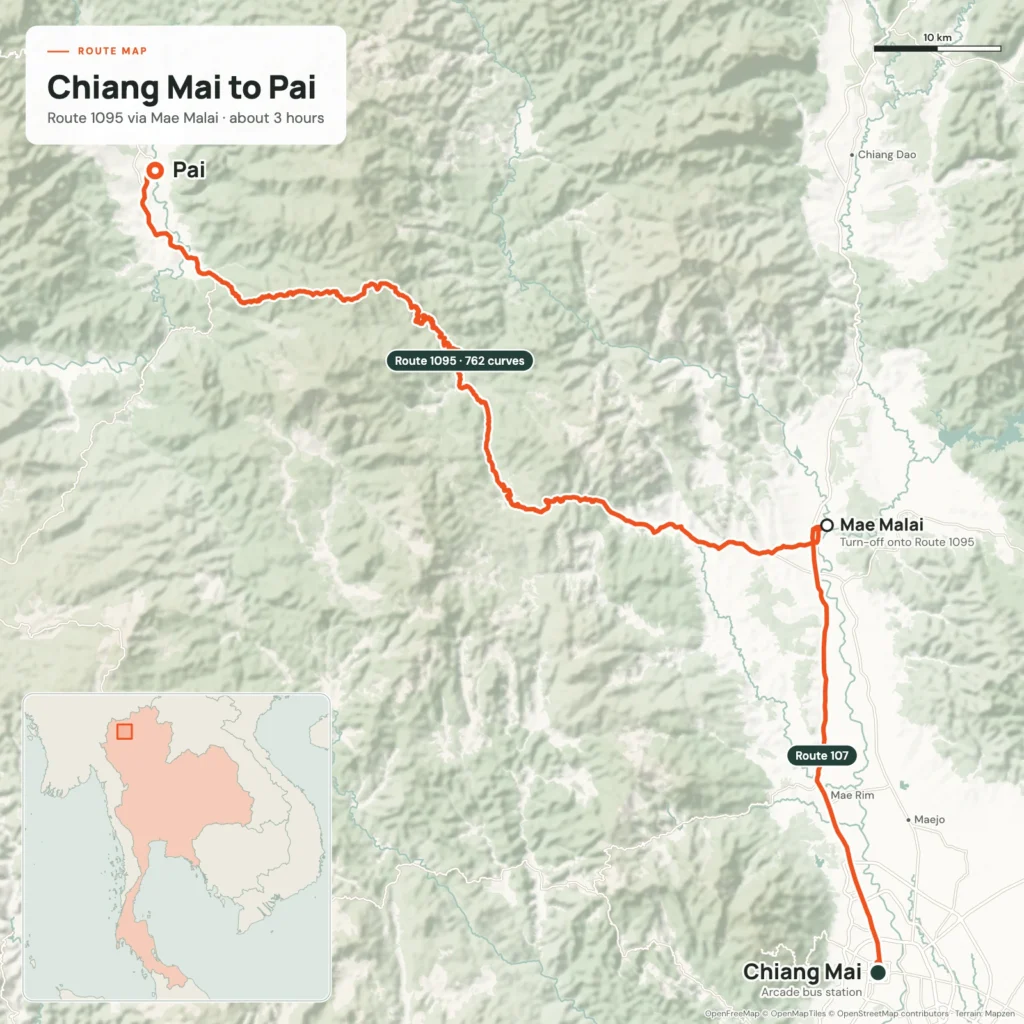
Elevation changes are significant too. The climb and the repeated corners are what make people sick in vehicles and what catch out inexperienced riders on bikes.
Realistic journey time is about three hours of driving, closer to four with a rest stop, pick-up and drop-off. Sources disagree a little, which is normal: traffic leaving Chiang Mai, weather and the driver all change the number.
Minivan: the default choice for most people
The scheduled service is run by Prempracha Transport from Chiang Mai’s Arcade bus terminal. A third-party check of its booking system for early October 2026 listed hourly departures from 06:30 to 17:30 at 220 baht per seat. Another travel site cites 220 baht for a van and 260 baht for a larger minibus.

Prices you see elsewhere vary. Booking through online platforms, especially with hotel pick-up, often lands in the 260 to 360 baht range because of platform fees. Buying at the terminal counter is usually the cheapest route. Check the operator’s own booking page before you pay a markup.
Good choice if: you want the simplest, cheapest way to get there and you are not especially prone to motion sickness.
The catch is: the drivers do this route many times a week and tend to drive it briskly. Vans are full, legroom is tight, and backpacks go in the back or on the roof. If you get carsick, this is the option most likely to make you regret the trip.
How to get a better minivan ride
- Ask for a front seat when you buy the ticket. Seats are often allocated at booking or on boarding, so go early.
- Take motion sickness tablets or ginger about 30 to 60 minutes before leaving, and check with a pharmacist if you take other medication.
- Eat lightly, keep your eyes on the horizon, and keep a bag within reach.
- Keep valuables and a charger in a daypack with you, not in the luggage space.
Scooter: the best ride and the biggest risk
Riding Route 1095 is the main reason some travelers choose Pai at all. You can stop at viewpoints and waterfalls along the way and use the same bike in Pai. It is also where many traveler injuries happen, according to local safety write-ups, and the road is demanding even in good conditions: tight corners, limited overtaking space, animals, gravel on the road and few streetlights after dark.

What it costs
Rental shop and travel site listings put a 125 to 160cc automatic at roughly 250 to 500 baht a day, with bigger bikes costing more. Fuel is extra. One-way rentals (rent in Chiang Mai, return in Pai) are offered by some shops for an added fee. Ask about it in advance and get the terms in writing.
For this road, a 110cc scooter is the weak choice. Several rental sources recommend a 150cc-class automatic for the climbs, especially with a passenger.
Licence and insurance: the part people skip
Thai law treats a scooter as a motorcycle. Tourists are generally expected to carry a home-country licence with a motorcycle category plus an International Driving Permit that also covers motorcycles, or a Thai licence. A car licence alone does not cover you. A rental shop handing you the keys does not make it legal.
The practical risk is not only the fine at a checkpoint. Many travel insurance policies will not pay for injuries if you were riding without the right licence, and medical bills abroad add up fast. Read your policy wording before you ride, and wear a helmet that fits.
Who should skip the scooter
- Anyone who has not ridden a motorbike before. Pai is not the place to learn.
- Riders without the correct licence and insurance cover.
- Anyone travelling with a large backpack. A big pack on a scooter affects balance, so send luggage separately or take a minivan.
- Anyone riding in rain, late in the afternoon or in poor visibility.
If you are comfortable on a bike, start early, leave Chiang Mai in the morning, avoid riding after dark, and take the stops. If you want to hire a bike once you are in Pai, rent it there after taking the minivan. This splits the risk: you handle the climb as a passenger and ride the flatter local roads.
If you are still planning your time in the city before heading north, our Chiang Mai travel guide gives the wider context on where to base yourself.
Private car: the better option for sensitive stomachs
A private car or van costs far more than a seat, but it changes the ride. You choose the stops, the driver can be asked to slow down, and you are collected from your accommodation. Sources cite roughly 2,000 to 3,000 baht for a car and 3,000 to 4,000 baht for a van, with some higher quotes, depending on the operator, vehicle and whether the driver waits at viewpoints. Higher quotes also appear for airport pick-ups.
It is still the expensive choice. Four people on minivan seats at 260 baht each pay about 1,040 baht in total, while a 2,800 baht car works out at about 700 baht each. The extra buys door-to-door pick-up and flexible stops, and for people who get very sick it is usually worth it.
Comparison table
Prices are indicative ranges from operator listings and travel sites seen in October 2026. They change by season, platform and vehicle.
| Option | Typical price | Time | Best for | Main trade-off |
|---|---|---|---|---|
| Shared minivan | About 220 baht at the counter, 260 to 360 baht online with pick-up | About 3 to 4 hours | Most solo travelers and budget travelers | Brisk driving, tight seating, motion sickness |
| Larger minibus or “bus” | Similar to the minivan, sometimes slightly higher | About 3 to 4+ hours | Travelers who want a bit more space | Hard to verify, same curves |
| Scooter (rent in Chiang Mai) | About 250 to 500 baht a day plus fuel, plus any one-way fee | About 3 to 4 hours with stops | Experienced, licensed, insured riders in dry weather | Injury risk, luggage, insurance gaps |
| Private car or van | About 2,000 to 4,000 baht per vehicle | About 3 hours plus stops | Groups, people who get carsick | Cost for solo travelers |
Booking and timing tips
- Book ahead at peak times. Thai public holidays, long weekends and the cool, dry high season (roughly November to February) fill vans quickly. In quieter weeks you can usually buy a ticket at the terminal.
- Rainy season changes the risk. The wet season runs roughly from May to October. Wet corners and reduced visibility make a scooter harder and a minivan journey slower. The Thai Meteorological Department publishes weather forecasts and warnings you can check before you go.
- Smoke season affects the ride. In the dry months before the rains, usually around March and April, burning can reduce visibility and air quality across northern Thailand. Check air quality before riding.
- Leave early. Morning departures give you daylight margins and fewer hours of fatigue, especially if you ride.
- Keep your luggage simple. Pack a small daypack with ID, medication and water. Heavy bags are easier in a van than on a bike.
If you are staying in Chiang Mai for a few weeks first, our Chiang Mai digital nomad guide covers areas, coworking and monthly costs. It helps you decide how long you can leave before the Pai trip.
Which option should you choose?
Take the minivan if you are solo, on a budget and not especially sensitive to motion. Take a private car if you are in a group or get sick easily. Choose the scooter only if you already ride, have the right licence and insurance, and can pick a dry day.
If you are unsure, go with the minivan up and rent a bike in Pai for the flatter local roads. It keeps the cost low and avoids the riskiest stretch.
FAQ
Is the road to Pai dangerous on a scooter?
It is demanding rather than impossible. Constant curves, wet surfaces and low visibility are the main hazards. Inexperienced riders and anyone riding in rain or after dark carry the most risk.
How long does the minivan take?
Operators and travel sites usually cite about three hours, with a realistic allowance of up to four hours including stops and pick-ups.
Do I need to book the minivan in advance?
Often not on quiet days, but book ahead during holidays and the high season, and if you need a specific departure.
What helps with motion sickness?
Sit at the front, eat lightly, look ahead, get fresh air and take a tablet or ginger before you start. Ask a pharmacist if you are unsure what suits you.