
Wondering where to stay in Chiang Mai? The right neighborhood depends on whether you are visiting for a few days, backpacking through Thailand or working remotely for a month. The Old City, Nimman and Santitham offer very different experiences, while Riverside and the university area suit travelers with other priorities. Here is how to choose a base that fits your budget, routine and travel plans.
Where to Stay in Chiang Mai: The Quick Answer
Stay in the Old City if this is your first visit and you want temples, markets and hostels within walking distance. Choose Nimman if you are a digital nomad who values coworking spaces, cafes and modern apartments. Consider Santitham if you want local food and potentially lower monthly rent. Riverside suits travelers looking for a more relaxed hotel stay, while the area around Chiang Mai University is worth exploring if you plan to stay longer and do not need to be in the historic center every day.
| Your travel style | Area to consider |
| First-time visitor | Old City |
| Solo backpacker | Old City |
| Digital nomad | Nimman or Santitham |
| Budget-conscious long-stay traveler | Santitham or university area |
| Couples and families seeking a quieter hotel | Riverside |
| Visitor interested in night markets | Chang Klan or eastern Old City |
How to Choose a Neighborhood in Chiang Mai
Chiang Mai is relatively compact, but that does not mean every neighborhood is convenient for every traveler. The city has no metro system, walking becomes uncomfortable during hot afternoons, and some major roads are difficult to cross. Staying near the places you visit most can make a noticeable difference to your trip.
For a short visit, prioritize walkability and convenient transport. If you are staying for several weeks, think about your everyday routine instead. A slightly cheaper apartment is not necessarily better value if you need two paid rides every day to reach your workspace, gym or favorite restaurants. For general accommodation costs, transport options and seasonal advice, see our Chiang Mai travel guide.
Think About Your Daily Transport
You do not need a scooter to enjoy Chiang Mai, particularly if you stay in the Old City or central Nimman. Grab and red shared trucks called songthaews are useful for longer journeys. However, visitors staying near the university, in outer residential neighborhoods or further along the river may need transport more often.
If you are considering renting a scooter, read our guide to renting scooters in Chiang Mai. Only ride if you have the correct motorcycle license, relevant insurance and suitable experience. Choosing accommodation that depends on a scooter is a poor compromise if you are not comfortable riding in Thai traffic.
Consider Your Work Schedule and Noise Tolerance
For digital nomads, the best location is not always the one with the most cafes. Think about where you will take calls, whether your accommodation has a usable desk and how far you want to travel to a proper coworking space. A quiet apartment near your regular workspace can be more useful than a stylish room overlooking a busy street.
Check recent reviews for aircraft noise, construction and nearby bars. Ask about Wi-Fi reliability and mobile reception before committing to a monthly rental. If you rely on video calls, a local SIM or eSIM with mobile data is a useful backup.
Old City vs Nimman: Two Different Chiang Mai Experiences
Old City and Nimman are the two neighborhoods most first-time visitors compare. Both have good restaurants, accommodation and places to meet people, but they suit different daily routines.
Old City: The Best Starting Point for Backpackers and First-Time Visitors
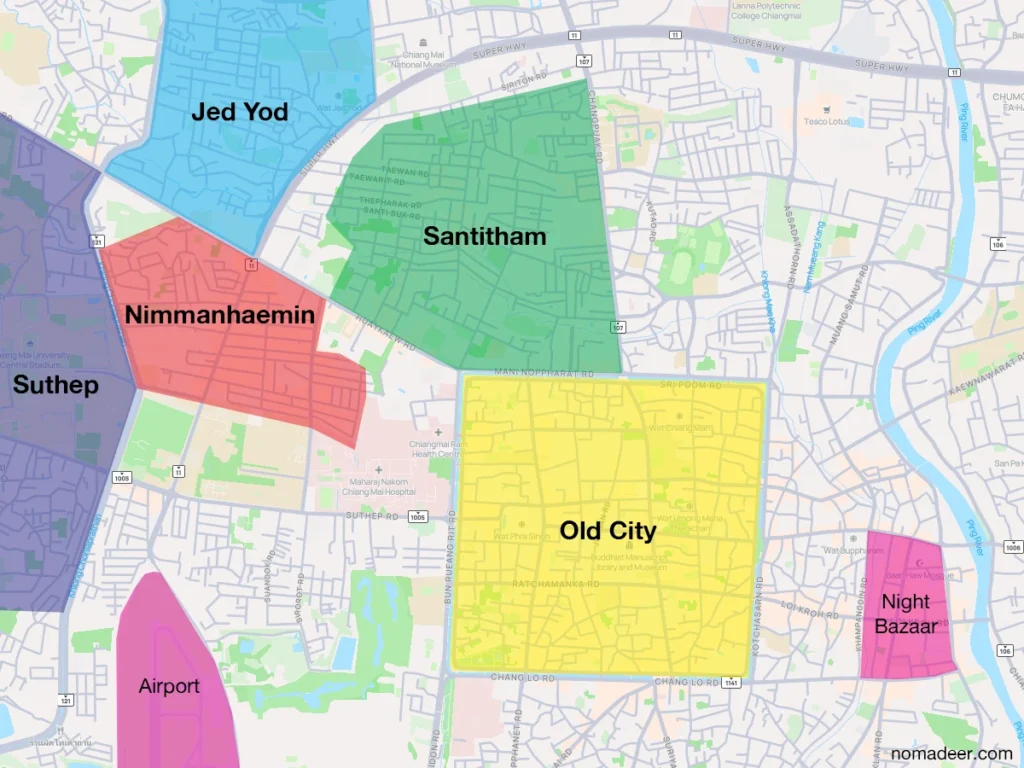
Chiang Mai’s Old City is the historic square surrounded by a moat and sections of the old city walls. It contains major temples, traditional guesthouses, hostels, restaurants and the Sunday Walking Street. If you are visiting for three or four days, staying here makes sightseeing much easier.
The eastern side around Tha Phae Gate and Moon Muang Road has plenty of backpacker accommodation, tour offices and restaurants. It is a practical location for solo travelers hoping to meet other backpackers. If you prefer quieter evenings, look at smaller lanes away from the main roads and popular bars.

The Old City offers accommodation across a wide budget range, from basic dormitories and family-run guesthouses to comfortable boutique hotels. Budget backpackers generally have more choice here than in Nimman’s popular central streets. However, hotels close to major landmarks can cost considerably more than nearby properties with fewer amenities.
Good choice if: You are visiting Chiang Mai for the first time, traveling without a scooter, staying in hostels or want temples and markets within walking distance.
The catch: Parts of the Old City are tourist-oriented, and popular streets can become noisy at night. Walking around the moat involves busy traffic, particularly near major gates. Accommodation directly beside a bar or the Sunday market route may be inconvenient if you need an early night.
If you want an evening activity beyond the walking streets and night markets, explore the local fight venues in our guide to watching Muay Thai in Chiang Mai.
Nimman: For Digital Nomads, Cafes and Modern Apartments
Nimmanhaemin, usually shortened to Nimman, lies northwest of the Old City. The neighborhood is known for independent coffee shops, coworking spaces, modern restaurants, shopping and a large international community. It is a practical base if you want to combine remote work with eating out, meeting people and exploring Chiang Mai during your free time.
The smaller streets branching off Nimmanhaemin Road have cafes, accommodation and restaurants. Yellow Coworking is one established workspace in the neighborhood, while the area around MAYA Lifestyle Shopping Center offers more shopping, food and everyday conveniences. Check current coworking opening hours, day-pass arrangements and call policies before planning your working week.

Nimman has boutique hotels, serviced apartments, modern condominiums and some hostels. Apartments close to its most popular streets can command higher rents than comparable properties in Santitham or less central residential areas. For a monthly stay, compare the total cost of rent, utilities, laundry and coworking rather than judging accommodation by the nightly price alone.
Good choice if: You work remotely, prefer modern conveniences, want plenty of cafes and restaurants nearby or plan to stay for several weeks.
The catch: Nimman has heavy traffic around its main roads, particularly near the MAYA intersection. Some accommodation is exposed to aircraft noise because of the nearby airport’s flight paths. It is also less convenient for walking to the Old City’s main temples and markets.
For remote workers, choosing an apartment a few streets away from the busiest nightlife areas may be more comfortable than living directly on Nimmanhaemin Road. Try the neighborhood for a few nights before committing to a longer rental.
Santitham, Riverside and the University Area
Old City and Nimman are not your only options. Several nearby neighborhoods offer a different balance of rent, convenience and everyday atmosphere. These areas are worth considering if you have already visited Chiang Mai or plan to stay longer than a typical holiday.
Santitham: A Practical Alternative to Nimman
Santitham sits north of the Old City and east of Nimman. It has local restaurants, small cafes, markets, apartments and a mix of Thai residents and longer-stay international visitors. You can reach both the Old City and Nimman without living in the busiest parts of either neighborhood.

Accommodation includes basic apartments, guesthouses and modern condominiums. Santitham can offer better value than central Nimman, particularly if you are happy with a simpler apartment rather than a building with a pool or extensive shared facilities. However, newer condos can still be expensive, so compare individual properties rather than assuming the whole neighborhood is cheap.
Good choice if: You want a longer-stay base, enjoy local restaurants and markets or prefer spending your accommodation budget on a better room rather than a fashionable address.
The catch: Santitham is less convenient for walking to the main tourist attractions. Some streets are narrow, and traffic can become busy around major junctions. Before booking, check the actual walking route to your nearest supermarket, cafe or workspace.
Riverside and Chang Klan: Comfortable Stays and Easy Evening Access
Chiang Mai’s Ping River runs east of the Old City. The Riverside area, particularly around Wat Ket and stretches north of the main tourist zone, has boutique hotels, restaurants and accommodation with river views. It can suit couples, families and travelers who want a more relaxed hotel stay.
Chang Klan is different from the quieter riverfront streets. It includes the Night Bazaar area, larger hotels, shops and busy roads. If your main priority is visiting night markets, eating out and having transport readily available, this side of the city can work well. If you want quiet nights, avoid assuming every hotel described as Riverside or Chang Klan will provide the same atmosphere.
Accommodation costs vary considerably. Riverfront hotels can be among the city’s more expensive options, while properties on ordinary streets away from the river may be more affordable. Compare the actual location before paying extra for a Riverside address.
Good choice if: You want a comfortable hotel, enjoy evening restaurants and markets, are traveling with family or prefer staying outside the main backpacker streets.
The catch: Riverside is not always as walkable as it looks on a map. Bridges, busy roads and the location of your hotel can make journeys to the Old City longer than expected. Chang Klan can also be lively and noisy near the Night Bazaar.
Near Chiang Mai University and Huay Kaew: For Longer Stays
The neighborhoods around Chiang Mai University and Huay Kaew Road have student-oriented accommodation, local restaurants, cafes and a wide range of apartment buildings. They offer an alternative for visitors who want to spend less on rent or prefer living outside the main tourist areas.
There is no single university neighborhood. The area around the main university entrance, streets along Huay Kaew Road and residential pockets further west can feel quite different. Some are within easy reach of Nimman, while others make regular trips to the Old City less convenient.
Monthly accommodation is a major reason to consider this part of Chiang Mai. Listings checked in September 2026 included examples near the university at around 7,000 to 13,000 THB per month, depending on the property and contract. Cheaper apartments and more expensive serviced accommodation also exist. These are examples of advertised rates, not guaranteed prices or an average for the neighborhood.
Good choice if: You are spending a month or longer in Chiang Mai, want access to local restaurants or are happy to travel into the center when you need to.
The catch: Some apartments require longer contracts, and cheaper rooms may have basic furniture, limited cooking facilities or additional electricity charges. Transport becomes more important the further you stay from Nimman and the Old City. Check the exact address rather than relying on a listing that simply says it is near Chiang Mai University.
Chiang Mai Neighborhood Comparison: Budget and Transport
The best area to stay in Chiang Mai depends on your daily routine as much as your accommodation budget. The comparison below uses relative budget bands, since nightly and monthly rates vary by property type, season and contract length.
| Area | Budget band | Good for | Transport |
| Old City | Budget to mid-range, with boutique options | First-time visitors, backpackers and short stays | Easy to explore much of the area on foot |
| Nimman | Mid-range to higher, with some budget options | Digital nomads, cafe lovers and longer stays | Walkable locally; rides useful for the Old City |
| Santitham | Budget to mid-range | Budget-conscious nomads and longer stays | Walking works locally; rides useful for longer trips |
| Riverside and Chang Klan | Mid-range to higher, with some cheaper properties | Couples, families and night-market visitors | Depends on the hotel; rides often useful |
| University and Huay Kaew | Budget to mid-range | Students and longer-stay travelers | Depends on the exact address; more transport may be needed |
For a short visit, compare the total cost of your room and daily transport. Paying slightly more to stay centrally can save time and repeated taxi fares. For a month or longer, compare apartments based on your weekly routine. A cheaper room within walking distance of your workspace may save more than an inexpensive apartment on the outskirts.
Booking Tips for Short Visits and Monthly Stays
Book Ahead for the Cool Season and Songkran
November to January is generally Chiang Mai’s most comfortable period for sightseeing, with cooler and drier weather attracting more visitors. Popular hostels, boutique hotels and well-located apartments can become harder to book during busy periods. Reserve ahead if you need a specific room type, reliable work facilities or a convenient location.
Songkran, Thailand’s New Year festival in April, brings major celebrations to Chiang Mai. Accommodation near the Old City moat and main festival streets can be particularly busy and noisy. Book early if you want to stay close to the celebrations, or consider a less central area if you prefer quieter evenings.
Check Air Quality Before Booking a Long Stay
Chiang Mai’s seasonal smoke is an important consideration, particularly from February to April. Agricultural burning, forest fires and weather conditions can cause severe PM2.5 pollution. The timing and severity change from year to year, so do not assume that any particular month will have consistently good air.
If you plan to work remotely during this period, consider accommodation with air conditioning, good window seals and suitable air filtration. Check recent air-quality conditions through Air4Thai before making a long, nonrefundable booking. Good neighborhood choice cannot eliminate the effects of severe regional pollution.
Compare Monthly Rates and Read the Contract
If you plan to stay for at least a month, ask accommodation providers about monthly rates instead of simply multiplying the nightly rate by 30. Guesthouses, serviced apartments and residential buildings may offer different prices depending on how long you commit.
A monthly rental is not automatically better value. Some apartments require deposits, minimum stays and separate payments for electricity, water or internet. A cheaper room can become expensive if electricity is billed at a high rate or you need to pay for daily transport and coworking.
For digital nomads who have never visited Chiang Mai, a practical approach is to book a few nights in the Old City or Nimman first. Explore Santitham, the university area and other residential neighborhoods during your first week. View apartments in person where possible, test your daily commute and confirm the contract terms before committing.
Check that your accommodation has a proper desk, suitable chair, reliable internet and enough quiet for your working hours. A comfortable apartment can save money and frustration over a longer stay, even if it costs more than the cheapest available room.
FAQ
What is the best area to stay in Chiang Mai for first-time visitors?
The best area to stay in Chiang Mai for first-time visitors is usually the Old City, because its main temples, restaurants, markets and hostels are close together. It is especially convenient for three to five days of sightseeing without a scooter. Nimman is an alternative if cafes and modern accommodation matter more to you than walking to historic attractions.
Is Nimman worth the extra cost?
Nimman is worth the extra cost if you work remotely, regularly use cafes or coworking spaces and want modern conveniences nearby. If you spend most of your time sightseeing or need to minimize rent, the Old City or Santitham may suit you better. Compare the entire cost of your stay, including transport and workspace access.
Where should backpackers stay in Chiang Mai?
Backpackers should stay in Chiang Mai’s Old City if they want hostels, social activities, affordable food and convenient sightseeing. The eastern and northeastern parts of the Old City have plenty of accommodation and places to meet other travelers. Santitham is also worth considering for backpackers planning to stay several weeks rather than a few nights.
Do digital nomads need to live in Nimman?
Digital nomads do not need to live in Nimman, although it offers convenient access to cafes, coworking spaces and other remote workers. Santitham and the university area can be practical alternatives for longer stays, while the Old City has its own coworking options. Choose a neighborhood based on your work schedule, accommodation quality and daily transport needs.
Can you stay in Chiang Mai without renting a scooter?
You can stay in Chiang Mai without renting a scooter, particularly if you choose the Old City, central Nimman or a location close to your everyday needs. Grab and songthaews can cover longer journeys. If you plan to stay outside the center, calculate how often you will need transport before deciding whether the lower accommodation cost is worthwhile.